Value proposition
I recently posted about my favorite business book, Understanding Michael Porter by Joan Magretta. Today I want to dive deeper into why the unique value proposition is the basis for all competition and strategy.
As a product manager, knowing what you're building and who you're building it for is the basis of what we do. This book strips that down to its bare essentials. And it's not just for "product people": it's the core of what any business does.
What is a value proposition?
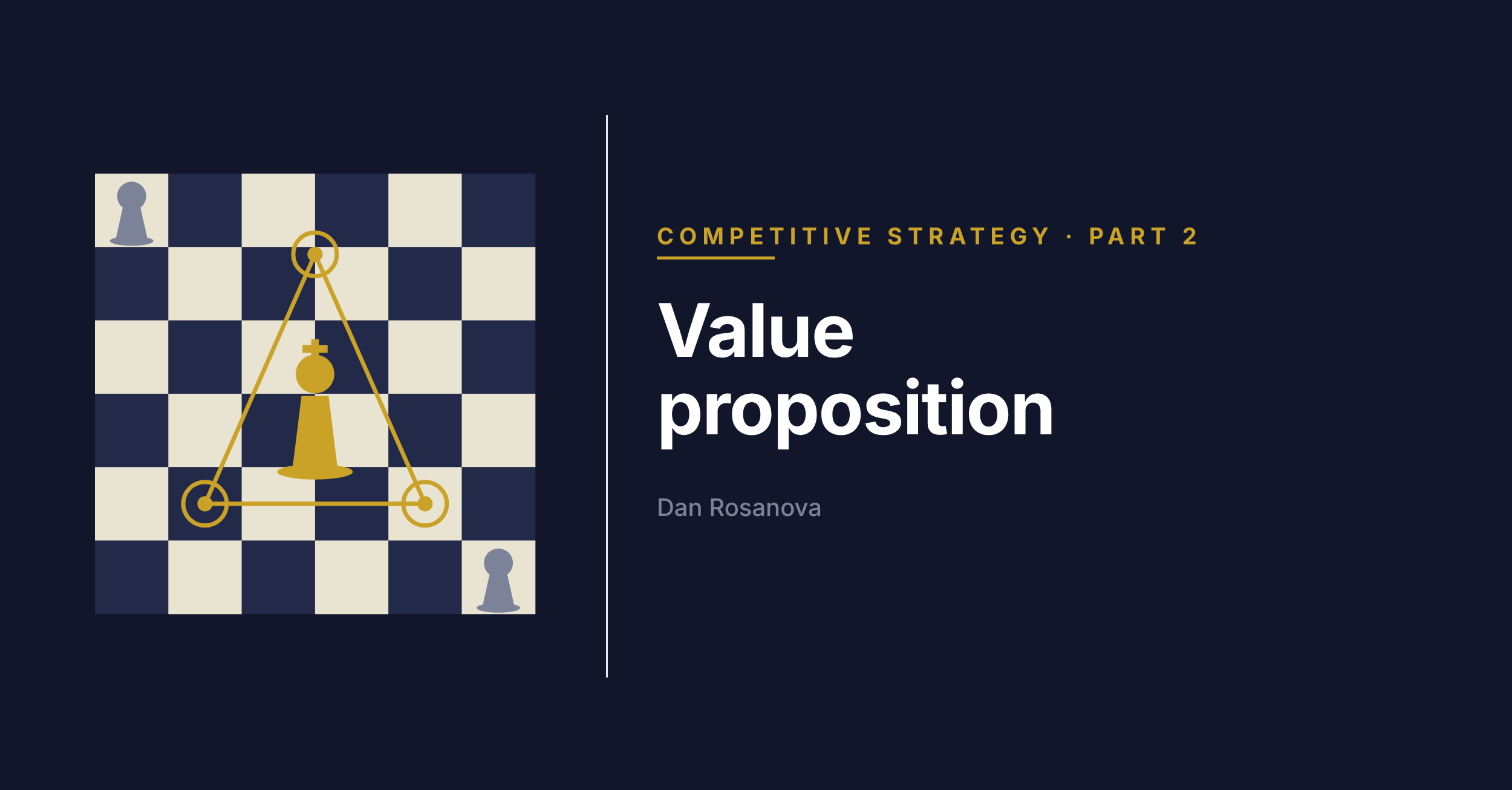
Porter's view of a unique value proposition has three questions:
- Which customers are you going to serve?
- Which needs are you going to meet?
- What relative price gives customers acceptable value and the company acceptable profit?
The critical part is these three decisions reinforce each other: they're the legs of a stool. As such they are deeply intertwined.
The objections I get to this model, created by someone who needs no defending from me, are many and varied. Some of my favorites are:
- Which customers? Obviously all of them!
- Which needs? All of their needs!
- At what price? Any price!
Founders in particular struggle with this. But it's the most essential part of building a successful and sustainable business. Every successful company has it, even if they never chose it on purpose. These choices can feel painful, but what you get in exchange is clarity and focus. Both of which are necessary precursors to success.
Which customers
Let's start with customers (you don't have to start here). Is your product B2B or B2C? Pick one. Honestly, this should be the easy part. Then narrow further: which segment of B2B or B2C users. There may be demographic, geographic, or needs-based ways to cut next, but make the cut. And keep cutting. Getting to your core customer is essential. It doesn't mean you won't serve others. It's just who specifically your company is building that product for.
Which needs
Now think about needs. You can't solve all of your customers' needs across their entire life: you need to pick a context. Are you providing infrastructure? Knowledge? Warm fuzzy feelings? That's not a joke: insurance is warm fuzzy feelings. Don't think in features here, think in the core problem(s) you solve for your customer. Then think about how. Are you high-touch or low-touch? Is this self-service or does every customer get a concierge? This ripples into both your customer and pricing choices. The product / service isn't just the technology; it's the whole thing, end to end. Your entire business: the product and how you deliver it. Ignore that at your peril.
What relative price
Now relative price. Remember: this is Porter, not me. There are only two generic strategies for relative price: cost leader and differentiator. You're either the lowest-cost provider or you differentiate to compete. The only other option is failing. Be realistic: at the core you're saying either "we compete by meeting needs in a unique way" or "we compete primarily on price." This is a most-significant-bit decision. You have to choose. True cost leaders turn down non-conforming customers. Are you prepared for that? You can't survive as the second-cheapest low-cost provider: you either are the cost leader or you aren't.
Price tends to be the most painful of these three for founders. Some treat money as a dirty concept or someone else's problem (often mine). Others think "we'll slap a price on at the end." Most think "why not everyone?" At its core, you're figuring out which part of the customer market you're really going after. The better you do this, the better your product / service will become. Your team won't be able to make a great product if they don't have this to guide them.
I think the place people get hung up most on price is they think they can be both cost leader and differentiator. That they can discount their way out of this decision. Especially in B2B. You can't. Some things are truly structural and inherent, and in the fullness of time they come to the fore.
Value proposition in action
This is more fundamental than most people realize, even in tech. TSMC is a differentiator that stays consistently ahead of every other fab. They don't compete on price, they're a premium offering. Being the largest fab gives them economies of scale too, but that's secondary. AWS, for compute and storage, is a clear cost leader. You never want to compete with them on price. One day I'll write a post about that.
Ever sit on a stool where the legs were not quite the same length? How'd that feel? The combination needs to fit together cohesively. Offer a premium product with high-touch sales and support at a low price, and you'll run out of money. Offer a low-cost, bare-minimum product to the broadest audience you can, and you have to accept that some customers will want something more differentiated (i.e. feature rich). You can't win them all. Don't bother trying. Be the best at what you want to be, then design your company and your product around that.
Accepting this model is actually liberating. It makes so much thrash and noise go away. When a competitor enters your "market," look at them and ask whether they're really a threat. Most of the time when people ask me about their competitors I find they are viewing the world through a zero-sum lens. They may be adjacent, but they're not often a direct competitor.
I've led multiple products that competed with AWS services, but it was never actually direct. Though I know a lot of sales folks who didn't feel that way. If you wanted the bare-bones, low-cost option, you went with AWS; if you wanted more, you went with my product. I never feared AWS. I thought they brought legitimacy to what I was doing. I wasn't dumb enough to fight them where they were strong (Sun Tzu is smiling somewhere).
Fight it all you want, but these three pillars are always there. The sooner you accept and work with them, the better off you'll be. Anthropic famously targeted professional developers with Claude. That was intentional and smart: they knew they were in a rivalry with OpenAI and decided to focus on a specific customer and needs combo. The customer is the professional developer and the needs are coding-specific. I suspect they also correctly understood that combo well enough to develop their differentiated experience, which tells us their relative price choice: they chose to be a differentiator, not a cost leader. Even if it took some time to get there.
Next time you use a product, look closely and you'll see these choices at work. Every business has them: hotels, airlines, automobiles, mobile phones. It's still relatively rare in AI, but being refined now.
Perhaps the best line in the book is:
"The first test of a strategy is whether your value proposition is different from your rivals. If you are trying to serve the same customers and meet the same needs and sell at the same relative price, then by Porter's definition, you don't have a strategy."
Read that again. If it struck a nerve, you're in a precarious position. Address it or someone else will find the weakness and disrupt you with it. Worse still, this disruption may be in a zero-sum race to the bottom. That race has no winners. As this great book lays out in the very beginning, zero-sum is competition by imitation rather than innovation.
Does anyone have a good story about a unique value proposition? Want my take? Name a company and I'll give it.
Also published on LinkedIn.